Saturday, June 30, 2007

more mysteries

Mystery #1:
When did this happen? Those storms only gave us a little wind, not much in comparison to what knocked down trees in the city only an hour or so down the road (& no rain). And that was days ago. No, it was all quiet for a few days, hot, still and muggy. I come around the corner of the house from the veggie garden and voilà! I think this rotten old limb was just ready to fall down!

You'll remember that this is the same tree which dropped another large part of itself across the drive in nearly the same spot not too long ago!

Mystery #2:

Every morning, I hear what sounds like the purr of a motor, the rapid-fire of a small hammer on wood. The bursts of sound go on for several seconds at a time, up to 1/2 a minute sometimes. Todd, the young man I hired to mow the lawn, said, the last time he was here, that he heard the sound too and followed it to an old tree at the corner of that old abandoned house across the laneway from my house. There, in the old tree, there is a huge hole. He thinks it's the nest of the pileated woodpecker that he saw in the tree.

Now, I recognize the call of the pileated w.p., but they haven't been noisy in that part of the farm -- perhaps so as to not attract attention to the nest. And the hammering is not like that I've heard in the past from the adults either. I mean, as my former housemate, Ann, used to say, the adults sound like they are "puttin' a serious hurtin' on the tree" when they are hammering away! I wonder if it is the young who make that noise, most often in the wee hours of the morning?

Mystery #3:
Can you see the corn?? Nope, I can't either!

I did have a nice row of corn coming up (I really did!!), but something wanted to eat it now -- before the corn could even grow enough to form any ears. I even tried reseeding the corn...and that too has been dug up.

This is peculiar, and here's why. Farmers around here have fields and fields and fields of corn, and not too far away at that from my own little garden, so close that I wondered about possible cross-pollination. Why is that that whatever dug up my corn seems to ignore the farmers' corn?

Now I don't know if it isn't perhaps a gardeners' myth, but I've heard talk that even wild birds at the feeders prefer organically grown/non-genetically modified seed. Could that be why the relative banquet not even a km away is scorned in favour of my teensy-tiny corn patch (which is now non-existent, by the way, because I'm giving up on corn for this season)?

Labels: , , , , ,

Friday, June 29, 2007

listening

Today is a national native day of action in Canada. Native groups are trying to draw attention to outstanding land claims and many other issues that Canada's native people want to educate us about.

I have been to one powwow in my whole life. It made a profound impression on me for many reasons. Today's day of action reminded me of something that occurred at that powwow that I have not forgotten.

Near the end of the day, an elder stood to pay tribute to a friend who had passed on. In the course of talking, he mentioned that he had had the opportunity to speak with one of our Prime Ministers. He wanted to speak to him about his personal experience of the abuse of native children in the residential schools. Perhaps the politician started to respond with the usual platitudes, because the elder said he told the Prime Minister:

"Wait. I want you to listen until I'm finished speaking. I will tell you when I'm done speaking."

We are not very good at listening, are we? We are already making up rebuttals, or thinking of something else perhaps completely unrelated to the speaker's words, or just waiting for an opening to jump in with whatever it is that we want to say ... anything but just listening.

Labels: ,

Thursday, June 28, 2007

pests and troubles

This is the post where I show you the dirty underside of my garden! You just might want to skip this 'cause it can get pretty ugly, particularly if your tastes go to the neat and trim style of gardening!

I'm an inconsistent gardener at best. I can be obsessive about every microscopic seedling one day, then too exhausted to think about it for days on end. During those days, the weeds march inexorably on in their bid to take over the garden and the tender seedlings of my 'intendeds' start to shrivel up, suffering terribly of neglect! When I get back into the garden, I swoon with guilt for a second or two. Then I get inspired to abuse my little 'intendeds' even further by yanking them up after I've decided they look better somewhere else. They get plopped into their new home, drenched with water and...to my amazement, nearly every time, my garden continues to surprise me with the determination of even my tender and abused 'intendeds' to grow and bloom!

I think that is part of the blessing that a garden is for me. In observing the beauty that results inspite of my bumbling interference, I realize that life is irrepressible! Life will come up for more again and again, inspite of everything that seems to be against it. Life is exuberant and abundant and gorgeous.

Oh, this is terrible! Is this evidence of Japanese beetles munching on my Apothecary rose?? And look at that! Those @#$% tawny daylilies persist, even though I thought I dug them all out of this bed beside the greenhouse!

Can you see the pig weed masquerading as basil in the middle of the row?? How did I miss that in my weeding? The root on that sucker will be as large as a Japanese radish!!

The cilantro last year seeded itself far beyond the original bed it was in, right into the path. I've already enjoyed many a meal in which the bright, musky flavor of cilantro just sang! But even I can't get to all the cilantro and in this heat, it is quickly going to seed again, as you can see. This is fine, actually. Only hitch with this is that it is now largely in the middle of what I intended to be a path through the garden and if it self-seeds here, am I going to revise the direction of the path to go round it?? I've found that lifting the seedlings of cilantro to move them to a "better" location doesn't work as easily as it might with say something like dill or fennel.

Bronze fennel generously seeded itself about, and where it's not a complete nuisance, I've just let the seedlings grow on. The fuzzy bits of the unfurling leaves did give me a start on first glance, making me think I was looking at a furry caterpillar! Of course, you see I'm not keeping up with the weeding, lamb's quarters, purslane and green foxtail grass being far too generous with their seedlings, thank-you very much!

The first little signs of fruiting on the tomatoes. I'm pretty relaxed about "pests", but I'm keeping out a very careful watch for the tomato horn worm (shud-d-d-der!!!!).

It started with just the ripening berries going missing. Now, it's not just the berries but most of the stalks as well that are being bitten right off! I should put netting over this bed. It's worth doing even this late because this is an ever-bearing variety and I could reasonably expect more berries all summer long.

Netting might keep out the critter responsible for the destruction -- unless it's a bug-like critter. I was going to say "thieving" but I think that's highly inaccurate as the critters with whom I share this world don't have any idea that I think I own the strawberries.

I have noticed earwigs are rampant in every part of the garden.

And we still have had no rain.

Labels: , ,

Wednesday, June 27, 2007

herbs and stuff

English lavender, Lavandula angustifolia. Look how attractive it is to butterflies! 'nough said.

Golden lemon thyme, Thymus x citriodorus 'Aureus', a gold-variegated form has a strong lemon scent.

Mother-of-thyme, Thymus pulegioides (T. serpyllum), a ground cover that perfumes the air when trod upon, wild thyme can be used in cooking and aids in clearing mucous congestion.
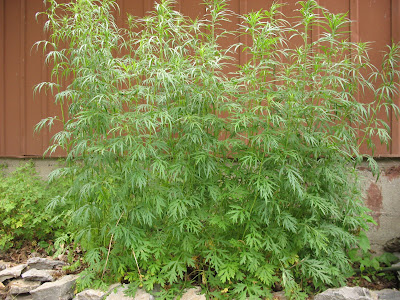
Absinthe, Artemisia absinthium, now illegal in some places probably because it has the reputation of causing madness, the extremely bitter absinthe leaves have been used flavor absinthe, vermouth and other liquers. The dissolution and madness portrayed by such famous painters as Degas were probably just as likely due to the residue metals in Parisian water, the 100 proof alcohol used to produce absinthe, or the unscrupulous use of additives to produce the famous green colour of absinthe. Absinthe stimulates the appetite, improves digestion and is one of the oldest known remedies for worms.

Siberian motherwort, Leonurus sibiricus; naturalized from Europe, motherwort is used as a vasodilator, diuretic and to relieve menstrual disorders.

Common mullein, Verbascum thapsus, (clary sage and lovage in the background )the erect, woolly stem with tightly packed yellow blooms on the flowering spike, rises from a rosette of thick, velvety basal leaves the second year. Common now in fields, roadsides and waste places in North America, mullein is a biennial introduced from Europe. All parts of the plant have uses, from the stalks dipped in grease for use as torches, the leaves used in moccasins or stockings to keep out the cold, to all parts used to produce yellow, bronze or grey dyes. Teas made from the leaves, flowers or roots are variously used as remedies for coughs, hoarseness, bronchitis, earaches and croup.

Satolina, Santolina chamaecyparissus, often seen in knot gardens or as low hedging, dried santolina flowers can be used in floral arrangements, or hung in bunches in closets to repel moths. The leaf oils are extracted for the perfume industry.

Ox-eye daisy, Chrysanthemum leucanthemum, the familiar wildflower of waste places, meadows, pastures and roadsides was introduced to North America from Europe. It can be employed to relieve chronic cough, asthma and nervous excitability.

Feverfew, Tanacetum parthenium, decorative and a prolific self-seeder, feverfew leaves in tea or even a few in a salad or sandwich are said to reduce the number and severity of migraines in some sufferers. It also reduces tension, gives a sense of well-being and provides some relief from arthritis.
Clary sage, Salvia sclarea: the attractive aromatic flowers are on a handsome sized plant. Collect the seeds. Soak the seeds in water to make a mucilaginous eye bath which safely removes foreign particles from the eye.

Lemon balm, Melissa officinalis, is an herb with a delightful lemon scent. The tea made from the dried leaves is said to stimulate the heart, calm the nerves, and is also effective against herpes. Fresh chopped leaves are interesting in green salads, salads made with mild beans like canneloni, added at the last minute to soups, or to season chicken or fish.

From left to right: lemon balm, Melissa officinalis, wonderful dried and used alone or in herbal tea blends; lovage, Levisticum officinale, the leaves with a relatively strong flavor reminiscent of celery can be used to flavor soups, stews and casseroles; carnation, Dianthus; clary sage, Salvia sclarea; French tarragon, Artemisia dracunculus sativa, the well-known culinary herb, suggestive of anise or licorice, used in such famous sauces as bearnaise, hollandaise and mousseline, lovely as the basis of a vinegar to flavor salads, or in butter over steamed vegetables and intrigueing in omelets, marinated meats or poultry stuffing. In the foreground, volunteer cilantro, Coriandrum sativum, its pungent, citrusy leaves a favorite in South Asian, Middle Eastern and Latin American cuisine, the seeds used to add a fresh, spicy flavour to soups, stews, chili sauces, and curries.

French tarragon.

Ooops. The idea was to capture a photo of the swallowtail butterfly caterpillars which were busy stripping the leaves of my lovage (Levisticum officinale) plant. But, I have missed them and they are probably in the chrysalis form now. I searched but could not find the chrysalis. My lovage towers way over my head, the flower heads resembling dill flowers.

Labels:

Tuesday, June 26, 2007

rapture

Where better than in a garden, can one contemplate the rapture of being alive?

Astilbe x arendsii 'Bridal Veil'.

And this is exactly what it looks like, the top-heavy flowering stalk of delphinium has flopped and snapped in the wind. It is supposed to be the shorter and sturdier variety Magic Fountains 'Sky Blue', but is obviously not short and sturdy!
I don't recall which varieties of geranium, hosta and fern these are...Every geranium variety I have is very attractive to insects: bees, small moths, butterflies.

Digitalis.

Clematis.

Pelargonium.

Verbena 'Ruby Queen' and Geranium 'Orion'.

Rosa 'Golden Wings', a bit chewed up by ?earwigs.

Since I refuse to use poisons in the garden, I must allow for some nibbles on the rose bush.

Dianthus.

Purple-flowering raspberry, Rubus odoratus. The bumble-bees are busy competing with the moths and bees.

The spent blooms of the iris are kind of interesting too.

The large mock orange bush was covered in heavily perfumed blossoms that were wildly attractive to all kinds of insects. The blossoms are just beginning to shatter now.

Labels: , , , , , , , , , , , ,

Monday, June 25, 2007

two weeks ago

I can't keep up. I notice something has opened up and I have every intention of getting a photo of it. Maybe I should just give up: recording it is as silly an obsession as the idea that I could possess everything beautiful, hold on to it somehow, delay the inevitable, push away the impermanence of life.


Labels:

Thursday, June 21, 2007

chemistry sets or guns?

Thanks to chuck b., of whoreticulture, my twisted mind was refreshed by good dose of insane laughter at the expense of the seriously stupid minds of too many politicians and legislators, when I read this, about the outlawing of basic chemistry equipment and supplies. We are sometimes uncomfortably close to our neighbour to the south, a neighbour that I often admire, actually; still...with our current government in power, the one that wants to be our neighbour's little brother ("me too!" "me too!" "me too!"), this is scary.

Read the comments too. There's lots of good stuff there too.

Labels: ,

Wednesday, June 20, 2007

90 percent!

This is amazing. I don't know if I have the patience to systematically think through everything that I consume, but you just have to be inspired by this story by Kate at Cider Press Hill. I think her story actually starts here at the Riot for Austerity 90% Emissions Reduction Project. I'm blown away by this! I'd love to hear about anybody inspired to try something similar. I'll have to think about this as there are several other things going on in my life at the moment...but it's so intriguing!

Labels: , ,

book crossings

I know a lot of people do this, leave a book they love behind on the bus, or train, or subway, with the intention that somebody else should also enjoy a book we've enjoyed. Now, if it matters to you, via urbanist , I found out about a way that those to whom this matters, can track the journey their book takes once it leaves your hands.

Anyone who has a book that they liked but don't want to keep is encouraged to register it at BookCrossing.com, write a note in the front, with the "Book Crossing ID," then leave it somewhere where others will find it.

Seems like a fun idea.

Labels:

Tuesday, June 19, 2007

until the full moon


OK, sensory overload here!
For some perverse reason, these peonies remind me of brides, and as cynical as I am, not believing much in the institution of marriage, the only reason I think of weddings in association with peonies is because they are so blowsy in their beauty, something like a bride in a very full and fluffy wedding dress.
Perhaps there are a couple of things that weddings do have to recommend them: a chance to wear yards and yards of lovely gauzy fabric and a big party afterwards! This, therefore, should not be a once in a life time event, should it?? New rule here, new rule: at least every 3 - 5 years, every woman should have a reason to get dressed up in impossibly frilly gowns just to feel beautiful and adored and there should be a big party afterwards!!
"Come, let us take our fill of love
until morning;
let us delight ourselves with love.
For my husband is not at home;
he has gone on a long journey.
He took a bag of money with
him;
he will not come home until
full moon."
~~Proverbs 7:18-20

Labels: , , , ,

Monday, June 18, 2007

titles

My Peculiar Aristocratic Title is:
Viscountess Kati the Querulous of Deepest Throcking
Get your Peculiar Aristocratic Title
In case you were wondering what my claim to fame was! There you have it. I was gratified to find my ah, ahem, title-ness via Ron, at Toad in the Hole.

Labels:

Sunday, June 17, 2007

The Eastern Churches

(March 19, 2007: Lalibela.)

Beta Qedus Gabrae'el Rufa'el:

The winding approach from the north, to the church dedicated to the archangels Gabriel and Raphael, is up an incline after crossing the River Yordanos, with the village on the east side. There is a large stone cross in the River Yordanos valley which marks the junction of tunnels that lead to Beta Qedus Gabrae'el Rufa'el and Beta Giorgis. Crossing another bridge over a rock-cut trench, the impressive facade of Beta Qedus Gabrae'el Rufa'el comes into view.


I'm sure I've muddled this up because I can't find references to it anywhere else. However, our guide said that at one time, the only access for the devout to this church was by climbing up the wall on the right hand side, above. The legend is that only the holy could successfully make the climb. And, if one fell off, what happened? Well, they would be going to "the other place"!

Now, a right turn takes us up to a covered gallery, the roof supported by elegant pillars. This gallery faces the northwest facade of the church across a trench 15m deep. One has to cross this trench on a third wooden bridge to reach the entrance to the church.

The church sits on a plinth excavated on three sides right down to the bottom of that 15m trench.

The facade, so elegant and exotic to me in the afternoon sunshine, has an ogee arcade with corbels formed by columns which are attached from top to bottom. The blind niches have doors in the third (above) and the sixth, with ogival windows on the wall of each of the remaining. This east doorway, the main entrance, is in Axumite style, with the square monkey heads in each corner. The west doorway opening out onto a high stone terrace is not visible in my photos and is shaped like the ogee arch and corbels of the arcade. The repetition of the ogee arch and corbels in the windows is quite pleasing to me.
I believe the stone pillars that form the railing of the bridge and the facing gallery were added during some reconstruction work and are not original. However, I think they were very thoughtfully done, and add to the overall design.


It is thought that this building was not originally a church because it has an irregular plan, with chapels that do not follow the conventional orientation of churches in Ethiopia. It might have been part of the royal palace.

From the western chapel doorway, which opens out onto a rock terrace, one has a view of the entrance gallery and bridge across the trench to the main steps and east doorway.

Passing back through the entrance gallery opposite the church, a tunnel leads into a rock chamber with a window which overlooks the east end of Beta Gabre'el. This room has this massive iron-studded door. Continuing down beyond this doorway are passages that lead to Faras Bet.
Faras Bet:

Faras Bet, means Horse House, and the legend is that this was Lalibela's stable. Or it may have been a beta lahm, (also called Arogi Bethlehem ) for baking the eucharistic bread. The upper openings would have allowed the smoke to escape.
Beta Marqorewos:

From Faras Bet, we took a long curving tunnel through several chambers, emerging at Beta Marqorewos. Also perhaps not originally a church, Beta Marqorewos is remarkable for eighteen of twenty massive stone columns that still survive. Although parts of Beta Marqorewos have collapsed, on one of the columns still visible are paintings of crowned figures wearing what might be royal robes.


Inside Beta Merqorewos, there is also a beautiful fresco done on fabric which is believed to date from the 16th century, added perhaps after it was converted into a church. Plastered onto the wall with a mixture of straw, ox blood and mud, it is thought to depict the three wise men.

Here, a phonolith (stone 'bell') suspended on a wall, has quite a clear ringing tone when struck. Naturally, some of us had to test this out for ourselves, to the amusement of a watching priest.
Sometimes, although the group of mostly English travelers in our group were ....well,....English, I think our guide found us a bit shocking.
At one point, he tried to patiently explain to us uncouth foreigners that women's shoulders should be covered in the churches, not, here he pointed to G.'s bare shoulders, dressed in their underwear. "Wha'??" she exclaimed in her broad accent. "I'm no' in me underweah!"
What ensued was much hilarity as our guide tried to find the word he had meant to say, while the rest of the group had a laugh at G.'s expense, with G. laughing the most. Of course, G. did cover her shoulders in the churches and this conversation took place earlier in the day, on the trek up the mountain to Ashetam Maryam, I think.
The group didn't seem to have much trouble understanding each other even though there was much ribbing of the different accents from various parts of England, Australia and Zimbabwe. Being the only Canadian, of course, I didn't have an accent (I did not!) and felt like I was often a beat or two behind the conversations at first. By the end of the trip, however, it was all too easy to start adopting G.'s lilting intonation, with the half swallowed syllables: "Wha' djew think? Shall 'e 'ave 'nathah beer? You 'kay, then?"

Bet Amanu'el:

One of the most magnificent of the monolithic rock cut churches of Lalibela, Bet Amanu'el, above, is of a grand Axumite style, from the doorways, to the windows and inside, the Axumite-style double frieze decorating the nave.
Isolated in a rock cut pit of its own, Bet Amanu'el stands on a plinth of three steps, widening by the doorways to four steps. Into the walls of the courtyard, little holes have been cut into the stone to attract the sacred bees.

We descended from the courtyard of Bet Amanu'el via a staircase, a tall and narrow tunnel, and more stairs to Bet Abba Libanos.


It is five o'clock. We are gently being urged to finish our tour so that we will get out of the way of the afternoon services of Lent. Already the faithful are arriving, the women covering their heads with the light cotton natala, the men with the shammas or gabi draped around their shoulders. In his hand, the man ascending the stairs is carrying a bundle of waxy tapers to use like candles.

Abba Libanos is unique because it is three-quarters cut, that is, freed from the rock on all sides, but attached by the roof to overhead rocks. The legend is that Lalibela's wife, Meskel Kebra, constructed this church in a single night, assisted of course, by angels.

Nearby, it was pointed out that there is a monastery-village where monks and nuns live in tiny caves 4m by 3m hewn out of rock.

By now, most of us were ready to contemplate hot showers, a meal and some fun out on the town, so visiting the monastery seemed a little incongruent anyhow.

Labels: , , , , , ,

Sunday, June 10, 2007

Na'akuto La'ab

(March 20, 2007: Lalibela.)

Na'akuto La'ab is a small church built under a natural cave found about 7 km outside of Lalibela, in the little village of Na'akuto La'ab on the way to the airport. It was built on the site of what was probably an older shrine by Lalibela's successor, King Na'akuto La'ab (13th century). The relatively modern inner red-brick building was added by the Empress Zewditu (20th century).

We visited Na'akuto La'ab in the early hours of the morning, giving ourselves enough time to get to the airport three hours or so before our scheduled flight in order to go through the check-in process and security checks.

This might have seemed like much too much time to me, especially when I saw the quiet at the in-country airports around Ethiopia. I wasn't even sure that our flight in and out of Lalibela was not the only plane that landed that day! However, as our group leader Danny confirmed in an email that described the trials he went through with the next group he took through Ethiopia, an Ethiopian airlines flight may arrive two hours early, a flight that we have been told will be a direct, non-stop flight, may actually end up making one or two stops or a flight may be cancelled altogether for that day. Poor Danny was on his cell-phone constantly, to reconfirm arrangements, but it happened anyway.

I guess I'm grateful that it didn't happen to our group, but then again, Danny did an excellent job of smoothing the way on many occasions I'm sure we were never aware of. Sitting at airports for 2-3 hours just waiting would have been very frustrating if I had not come prepared with a couple of paperback novels.


Anyhow, back to Na'akuto La'ab.

Inside the outer security wall, we found a group of dabtara chanting some of the extensive and complex liturgy of the Ethiopian church. With some faltering upon our distracting entry, they however kept up the repetive, wailing chant while we wandered about.


Our guide (sorry, I have forgotten to find out what his name was), as was his habit, sat us down to give us a short summary of the history of the church, then led us first to view the treasures kept here (crowns, crosses, icons, an illuminated Bible and a gold-painted drum).

Then we went deeper into the sanctuary where holy water drips from the roof of the cave into several stone basins. No, I didn't have the nerve to sample any of the water; one, because I, particularly as a woman might be overstepping bounds of propriety; two, because I didn't fancy picking up some water-born bug that might make me ill so early on in my trip!

Heeding the warning that wandering about on the rug and rush covered floors of the rock-hewn churches of Lalibela would be a flea-infested experience in our sock feet, I did slather on the insect-repellent the first day. However, that proved to be completely unnecessary there and throughout the whole of the rest of my time in Ethiopia. Mosquitoes also were not a problem at the high altitudes. I did not even see mosquito netting until I was in the lakes' district south of Addis Ababa near the end of my trip! One of our group did get several bites along her inner forearms at the very beginning of our trip in Lalibela and I also had similar bites much later on, perhaps acquired while trekking. While the other girl's bites became inflamed and itched severely, I had no reaction to my bites at all. I was never quite certain what had caused them and although they itched a little, they quickly healed up.

Most of the young boys and girls who engaged us in conversation in Lalibela were scrupulously clean, even though their clothes might have been ragged and worn. However, toddlers and children who did not seem to be attending school, playing in the everlasting dust, were ... dusty!

Lalibela often suffers from water shortages. I can't imagine being a poor mother trying to keep children clean and healthy without plenty of water!


Ah! So that's how it's done! I am always curious about how the tukuls are built. Needless to say, this is not what I expected. Like a lot of things in life, my expectations are often turned on their head!

Danny, our group leader, kept trying to hurry us back to the bus so that we'd be on time at the airport. How can one hurry through scenery like this, I ask you!!

Labels: , , , , , , , , , ,

Saturday, June 09, 2007

Ashetan Maryam

(March 19, 2007: Ashetan Maryam, Lalibela.)

A true traveler expects to find quirks and differences in hospitality wherever one finds oneself. When you travel around Ethiopia, the difficulty of providing what a western tourist might expect becomes understandable when you start to grasp the enormity of overcoming the geographical barriers alone, never mind the lack of infrastructures that make a completely different level of construction projects relatively easy in the more developed west. I mean, most entrepreneurs attempting such projects in Ethiopia are not Vanderbilt, who built himself a railroad to bring just the right kind of stone from Wisconsin or Michigan or wherever it was, didn't he, for the construction of Biltmore in North Carolina, dismantling the whole railroad when he was done.

However, if you can adapt to some inconsistencies (eg. funny plumbing that exhaled noxious fumes from the bathroom and a warped bathroom door which did not allow me to keep the noxious fumes contained in the bathroom), hospitality in Ethiopia has definite charms. After all, I did not go to Ethiopia to find a McDonald's experience and I've had worse service and accommodations in the U.S. and Europe. Here, I found the handmade furniture and bed covers in my room in Lalibela (photo below) just made me silly-happy.


Meeting in front of the open-air dining room of our hotel in Lalibela, we are heading out at the crack of dawn this morning to climb to an altitude of 3150 m. Ashetan Maryam, the monastery we are visiting this morning sits on a mountain overlooking Lalibela and there are fabulous views from the top. We could, conceivably, take a bus ride on a road that skirts around the back to nearly the top. But we are also testing our abilities today, in preparation for the demanding hiking to come later, in the Simien Mountains.

The morning Lent services have been broadcast over Lalibela over loudspeakers for a while now, the willful wind snatching the chanting away, then flinging back to us fragments of the songs of the dabtara or choir.

Bits of the services that I remember from seeing in childhood always seem to include the dabtara or lay cantors who intone the complex liturgy of the Ethiopian church, swaying in time to the music or even taking ritual steps called aqwaqwam. As the services are incredibly long, often lasting all night, particularly at Timqat (the feast of Epiphany, celebrating Christ's baptism, January 19), the dabtara often lean on maqwamia or prayer sticks. The maqwamia look somewhat like crutches often having a metal head with a double volute and are used to lean upon during long services, or to mark the rhythm of the chant.

During Lent, the sistras and drums which accompany the chanting during other times, are silent.

Unfortunately, my parents probably displayed some European ethnocentric disapproval when they first encountered the Ethiopian style of worship (dancing!!) those many years ago, still lingering particularly in my father, gentled somewhat however, as they saw more of the world and learned more in the years to come. Now my mother often laughs at the Finnish stoicism in many public events where she always points out the lack of smiles, or the way a religious choir appears to make no effort to engage the audience. Ah, cultural divides! Are they any less vast today than they were 50 years ago?

In the chill morning air we head eastward out of Lalibela, accompanied as always by a crowd of young boys, trying out their English:
"Hello. How are you?"
"What is your name? I am student."
"Where are you from?"
Some appear quite happy to trek with us all day, and out of nowhere, touts leading mules that have been saddled up in colourful style also appear to offer the option of riding up the mountain, for a price, of course. But firm, curt words from our guide send them away and we are left in peace to travel up the track. But we are not alone. There is traffic, other people travelling up and down the mountain, walking, riding on a mule, guiding heavily loaded donkeys. We are not the only ones on the move.

The red volcanic rock, into which the churches of Lalibela were so mysteriously carved, appear below as we round a bend in the path.

A construction crew is already at work, making improvements to the path. The division of labour seems to be that the men work the pick axes and shovels, the women carry rocks and dirt from one spot to another in sacks.


We meet wood-carrier women bringing firewood for sale in Lalibela. As removed as we are in North America from most of the things we consume without doing much more than punching "continue" on our computer screens to complete the transaction, seeing the back-breaking labour of the wood-carrier women and their children, invites us to contemplate the actual cost of our life-styles.

Lalibela recedes behind us, people on the path becoming mere specs. I am out of breath, but I'm determined to get to the top and back.

After a steep climb, the land flattens out again for a long hike through farmland, the typical circular homes called tukuls in yards that are often surrounded by plantings of eucalyptus. It is spring. Everywhere, the land is awaiting plowing or being plowed for the spring plantings of barley, tef and beans. Where it is not being plowed, shepherd boys tend sheep, goats and cattle. Here and there a hobbled horse grazes. Livestock in Ethiopia probably outnumbers people 5 to 1. There is evidence of overgrazing everywhere, trees are scarce and erosion must occur in a massive way during rainy season.


These adorable munchkins were shooed out to the side of the path to intercept the ferengi when their mother spied us on our way up to Ashetan Maryam. I'm sure she is instructing them to look as cute as possible. The children are timidly calling out to us, "hello, hello, hello, birr, birr, birr, photo, photo, photo..."

Impossible to imagine the massive farm machinery I am accustomed to seeing at back home in the Kawartha Highlands manoeuvring this job in the challenging slopes of the highlands of Ethiopia, agricultural practices seem to be of another age. However, it is argued that the famines of the recent past have for the most part been exacerbated by politics. Traditional ways of saving part of the yearly harvest for the lean years fed the population well for centuries, a precaution that would have continued to serve well but for the depredations of the farmers' stores by warring tribes and unscrupulous dictators. The years of the Derg under Mengistu were a brutal example of using food for political advantage.

The beauty of the landscape is everywhere. The sharp sound of the crack of his whip rolls out in the thin mountain air and the man calls directions to his oxen.

Green! The first bit of rare green I saw in the countryside aside from the eucalyptus trees. I was told this is barley. I was later to encounter a delicious barley snack. Barley is usually ground into flour in Ethiopia. Combined with other grain flours it is used to make soup and drink. It is also used to brew an Ethiopian home made beer called tella.

Buna, anyone?

Tukul perched on the steep side of the amba (the flat-topped mountains that are so often a part of the northern landscape in Ethiopia). Here again, the colourfully saddled mules were offered to the flagging. Nope, I was still determined.

Here in the shadow of the cliffs, you can see the trail going up to a cleft in the rock through which one climbs to the top and Ashetan Maryam. All along the way, the plant life invites me to stop and look. I'll post about them later.

Not yet noon but the sun is getting hot. At the base of the cleft in the cliff, a spring looks cool and inviting, ferns enjoying the moisture. But we have to climb on. And suddenly we are there:


The monastery of Ashetan Maryam atop the mountain is surely not impressive for its architecture when compared with some of the churches of Lalibela. However, its quiet aerie does give the impression of the peaceful and contemplative life the monks are said to enjoy here 'closer to heaven and to God'.

Construction is said to have been started during King Lalibela's reign and was finished between 1207 and 1247 during the reign of King Na'akuto La'ab. Church treasures are brought out for us to see, icons and priceless parchments. It is also said that a tunnel connects Ashetan Maryam with the churches of Lalibela miles below, but nobody has traversed that tunnel for unknown numbers of years.

The sunshine after the dim interiors is blinding!

The views from atop the cliffs near Ashetan Maryam are truly breathtaking. I wonder with great anticipation what the Simien Mountains will be like!

We opt to go back down the way we came, to give us time to see the eastern group of churches in Lalibela in the afternoon remaining to us before we leave for Axum in the morning.


The construction work continues and we meet people going home from the Lent services in the churches of Lalibela below.

On the way down we meet a couple of very handsome young men on their way home from morning classes at the high school in Lalibela. They live up beyond Ashetan Maryam and make this trip at least a couple of times a day to attend school. They smile gently at our fatigue.

Labels: , , , , , , ,